





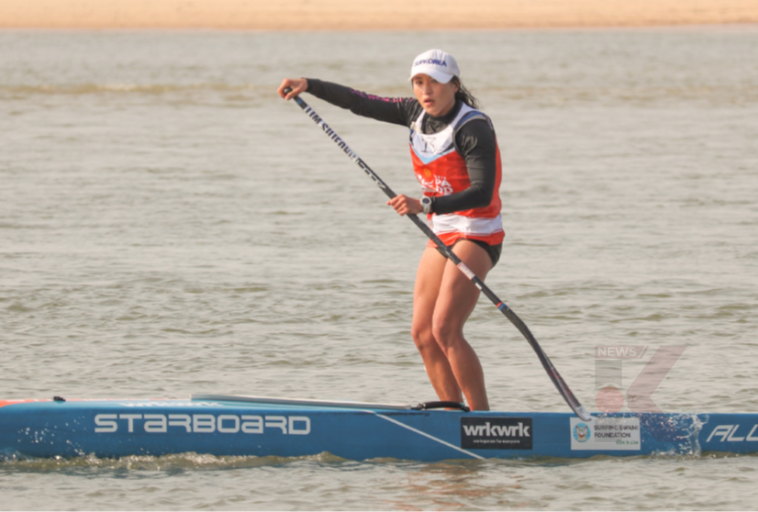
Deekshith R Pai reports on India’s first ever international stand-up paddle festival that was underway at the Sasihithlu beach in Mangalore, Karnataka, where participants from as many as 13 countries were participating along with India’s national champions.
The hot afternoon sun was slowly taming down to the cool evening sea breeze. A line of onlookers, with their caps and sunglasses, along the beach were scanning into the distant waters. This was at the confluence of the Nandini river with the Arabian Sea at the Sasihithlu beach. There was a sudden commotion from the participants perched atop the under-construction sea walk. The cheers went viral and was carried forward by the audience awaiting on the beach and they got the first glimpse of an athlete crossing over the mouth of the confluence and entering the sea, balanced atop her board and paddling hard.
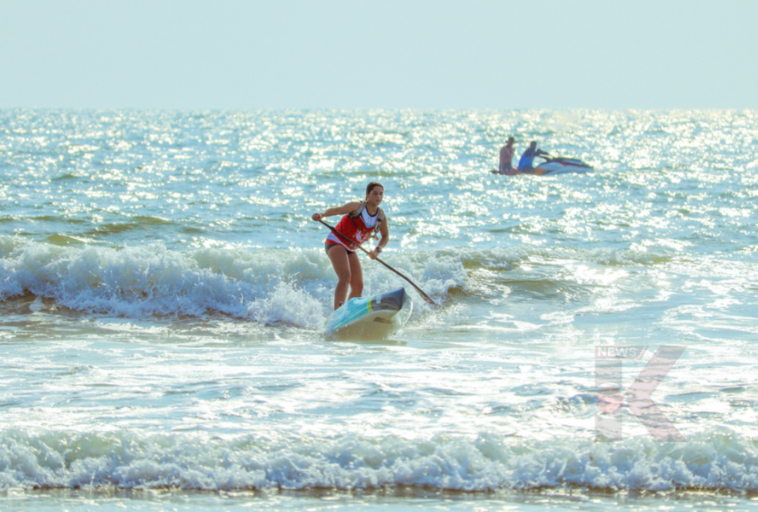
“The weather and the current make the competition challenging. Though I am used to this weather back in Canary Island, my heart rate went high because of the heat. But this is my first international event and I enjoyed it thoroughly and I too wish to come back.” – Bianca Tonicelli
India’s first ever international stand-up paddle festival was underway at the Sasihithlu beach in Mangalore, Karnataka, where participants from as many as 13 countries were participating along with India’s national champions. The India Paddle Festival was organised by Surfing Swami Foundation in association with The Association of Paddle Surf Professionals World Tour, The Ministry of Tourism under the Karnataka Government, The Mantra Surf Club, independent volunteers and the local villagers of Sasihithlu.
“We wanted to organize something different. We have been organizing various beach festivals in Mangalore and we have conducted surfing events in Sasihithlu. Paddle surfing was an interesting option and we also saw it as an opportunity to promote this sport in Mangalore,” says Yatish Baikampady, a core team member of the festival and a popular figure in the organizing committees of various beach festivals in Mangalore. He adds, “This time we decided to challenge ourselves and take it international. It was a first time for India to be hosting an international level paddle surfing competition. Though the permission came late, we along with the volunteers, worked day in and out to spread the word and put up the show.”
“Mangalore, especially Sasihithlu, has a huge potential to develop as a water-sports destination. That is why we pushed the government to pave the roads to the beach, back in 2017, so as to develop it as a popular destination. The communities here were very happy to see the developments over the years.” – Yathish Baikampady
As he spoke, the cheers became louder. Paddler Esperanza Barreras from Spain paddled across the last point in the waters, ran across the beach and triumphantly crossed the finish line to be declared the champion in the Women’s Technical Distance Open competition. Barreras was all praise for Mangalore.
“It was a fantastic competition. The conditions here like the wind speed, the waves and the current keep changing which challenges you and I really like that in a competition. Also, the people and the place have been very supportive. I hope to come back here in the future,” she says. She is joined by the 15-year-old Bianca Tonicelli who finished third in the same competition.
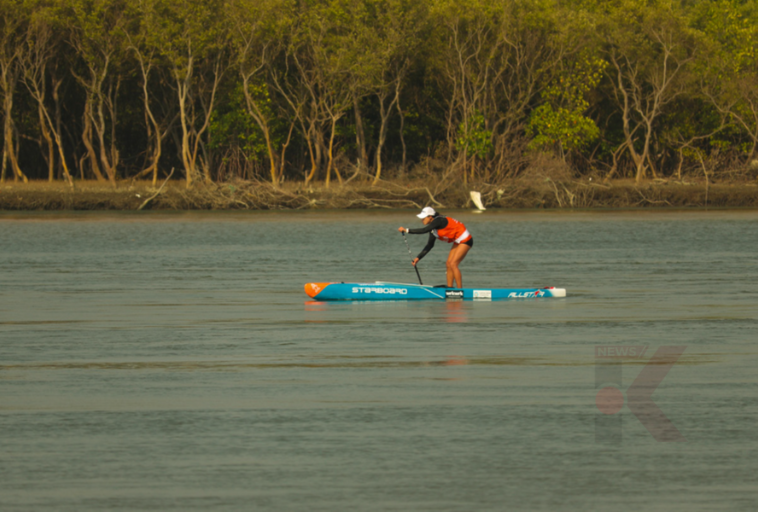
“The weather and the current make the competition challenging. Though I am used to this weather back in Canary Island, my heart rate went high because of the heat. But this is my first international event and I enjoyed it thoroughly and I too wish to come back,” she says.
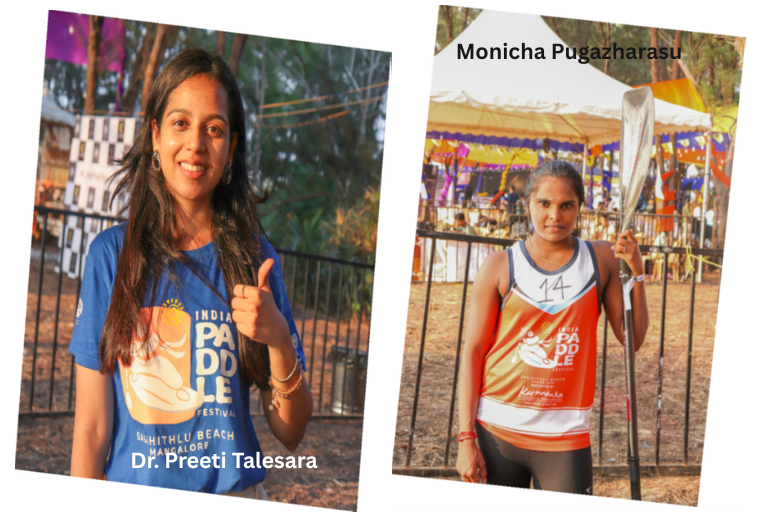
“The health challenges due to the weather persists. There is high risk of dehydration among paddlers. Paddlers also face muscle cramps and severe back pains during paddling. But luckily there have been no major cases here and we have got a full medical team ready for their support,” says Dr. Preeti Talesara a physiotherapist from Mumbai, who is volunteering at the festival.
“Mangalore, especially Sasihithlu, has a huge potential to develop as a water-sports destination. That is why we pushed the government to pave the roads to the beach, back in 2017, so as to develop it as a popular destination. The communities here were very happy to see the developments over the years,” says Baikampady.
“This is my first International Stand-Up Paddling competition. Though I have won National championships, when competing with international paddlers, it is a different ball game. There is a lot to learn from them and their techniques,” says 18-year-old Monicha Pugazharasu.
The beach was decorated with colourful hangings and archways along with strings of warm lights to welcome the spectators. The festival was not just restricted to the paddle surfing competitions. There were multiple cultural events, beach-based competitions and a first of its kind adventure film festival. Every evening the beach would pave way to hundreds of spectators seated across the stage to witness the evening’s offering of entertainment.
“Every beach festival usually has workshops or food fiestas that happen side by side. But we wanted to do something meaningful for the audience. Hence, we came up with the idea of an adventure film festival where we contacted adventure sports professionals and collected their films or documentaries, they had put together, that spoke about their sports. This would not only entertain the Mangaloreans but also educate and encourage them to look at sports more seriously. Even if there are just ten or twenty viewers, we are happy,” says Gaurav Hegde, the director of Surfing Swami Foundation and a core team member of the festival. He was proven wrong that day. There were at least a hundred seated viewers and another hundred moving crowd who watched the films with rapt attention. Many of them were also from the fishing communities from the villages nearby.
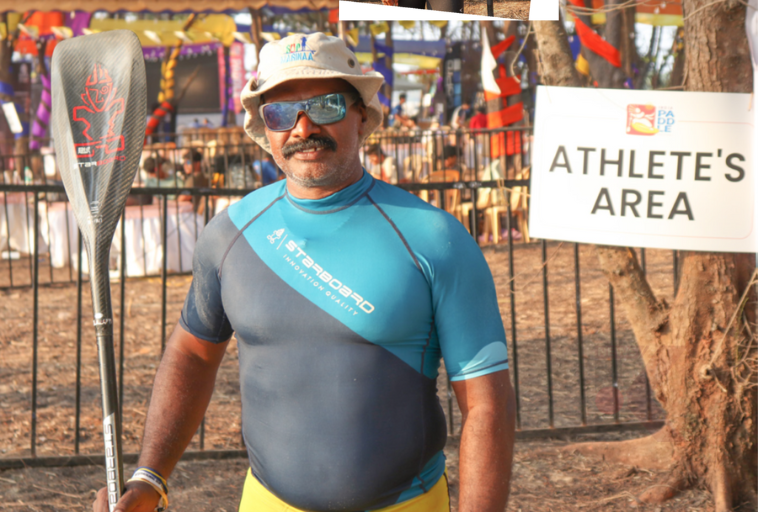
“I was a fisherman before I started surfing 16 years ago. I was encouraged to pursue stand-up paddling after witnessing it at Kovalam beach near Chennai. I’m a self-taught surfer and after I got a sponsor, I took it as a full-time career.” – Sekar Pachai
“One of our core goals is to engage the local communities in the festival. The local fishing communities know the sea like no one else. If they are trained in the sport, they can bring multiple laurels to the country,” says Baikampady. There is no better testament to this than the national stand-up paddling champion Sekar Pachai from Chennai, who also finished fourth in the Men’s Technical Race at the festival.
“I belong to a fishing community. I was a fisherman before I started surfing 16 years ago. I was encouraged to pursue stand-up paddling after witnessing it at Kovalam beach near Chennai. I am a self-taught surfer and after I got a sponsor, I took it as a full-time career. I started my own club a couple of months back to encourage people like me to take up water sports seriously. It is a difficult choice given that it is an expensive sport,” Pachai says. He is backed by Satish Kumar, founder of SUP Marina Club at Marina beach, Chennai.
“A professional stand-up paddling board cost around Rs.2.5lakhs, which is unimaginable for a local community member. The cost of practicing this sport is very expensive. Hence, at my club, I provide the students with paddle boards that I have collected over the years. I have trained around 50-60 students from the fishing community till date who have represented India at international championships.” This idea is also shared by Surfing Swami Foundation.
“Knowing that the sports could be expensive for the local communities in Mangalore, the foundation wants to support them with equipment and training and also send them to competitions across the world,” adds Baikampady.
Events like India Paddle Festival in Mangalore also gives the Indian paddlers a platform to understand world competition.
“This is my first International Stand-Up Paddling competition. Though I have won National championships, when competing with international paddlers, it is a different ball game. There is a lot to learn from them and their techniques,” says 18-year-old Monicha Pugazharasu from Chennai and a student of Kumar. She was also the only Indian woman to have completed the Women’s Technical Distance Open at the festival.
Pachai adds to this, “Mangalore is a challenging location. We usually paddle either in still waters or rivers or seas. But here it was a mix of the river and the sea. The international paddlers did an amazing job in this location as they have been trained in it. India needs more such competitions for us to get a good exposure to different conditions and learn from international champions.”
“Every beach festival usually has workshops or food fiestas that happen side by side. But we wanted to do something meaningful for the audience. Hence, we came up with the idea of an adventure film festival.” – Gaurav Hegde
The festival also has the potential to boost the local economy.
“Both the competitors and the spectators come not only to engage in the festival but also to experience the local culture. We could help the local communities organise a food festival to promote their local cuisines or engage them in the cultural activities promoting their art forms,” says Baikampady.
Dr. Priyadarshinee from Chennai is an example of this. She is a paddle-surfing enthusiast and has travelled to be a part of the festival.
“I am not a professional paddler. I just came to participate and understand the festival. I also loved the Mangalore cuisine and the place a lot. I might even come back to visit the other places here,” she says.
The festival can also be a combination of many events to attract larger crowds.
“Next time we will be developing a full calendar along with the festival. We will include when and where the other cultural events like Yakshagana or Bhoota Kola is happening in the city. We are also planning to collaborate with artists in Mangalore and hold an art festival alongside the beach. Such experiments can be a big encouragement for the local communities as well,” concludes Baikampady.
The health challenges due to the weather persists. There is high risk of dehydration among paddlers. Paddlers also face muscle cramps and severe back pains during paddling. But luckily there have been no major cases here and we have got a full medical team ready for their support.” – Dr. Preeti Talesara
The Pilivesha performance was in full swing on the stage. The sun had set and the beach was only recognisable by the sound of the waves. The audience had gathered in huge numbers around the stage to witness the acrobatics performed by the young bloods. Suddenly, a boy on the one end of the stage performed the famed fire breathing. An uproar went across the crowd and the outsiders were in complete disbelief. They could not get enough of it. And the local villagers looked on with pride.
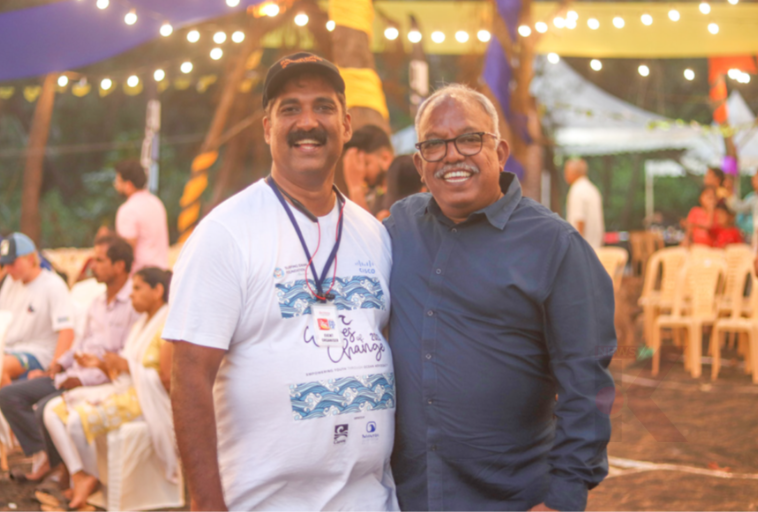
Gaurav Hegde, the director of Surfing Swami Foundation with the core team member of the festival Yatish Baikampady.
Surfing Swami Foundation
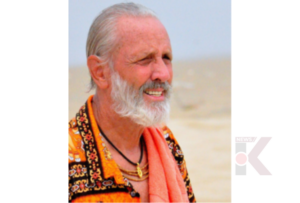
In 2014, Hebner initiated the Surfing Swami Foundation with an aim to impart environmental awareness and promoting surfing, especially among the underprivileged children.
Jack Hebner, popularly known as the Surfing Swami, is often accredited with introducing India to surfing. His journey from the beaches of Jacksonville in Florida to pioneering surfing in the west and east coasts of India is nothing less a fairy tale. Inspired by the Hare Krishna movement, Hebner came to India in the 1970s to learn Sanskrit and travel across while also carrying alongside his passion for surfing. Amused by his activities on the beaches, the locals soon became not just his spiritual disciples but also surfing students. He travelled through the beaches of Tamil Nadu and Karnataka, each time sowing the idea of surfing and each of which have grown today into surfing academies.
On a similar visit to Mangalore in 2004, he came across the beautiful beach of Sasihithlu and decided to start India’s first surf school, The Mantra Surf Club. Over the years, Mantra Surf Club and Sasihithlu became synonymous with surfing and Hebner trained hundreds of students and visiting tourists the art of surfing.
In 2014, Hebner initiated the Surfing Swami Foundation with an aim to impart environmental awareness and promoting surfing, especially among the underprivileged children. Through SSF, children belonging especially to the fishing communities, are provided scholarships and free training to compete in surfing at international levels. SSF also conducts regular festivals, international competitions and beach clean-up drives to promote environmental awareness.
The Surfing Swami passed away in 2020. But his legacy is carried on even today by the members of the Foundation and the Club.
This story appeared in the launch issue of South Canara Chronicle monthly magazine published by this media house.